Vision GRPO
Category: multimodal RL; dataset: GeoQA; accuracy 71.0% → 87.0%
On a fixed set of 100 GeoQA test questions, the
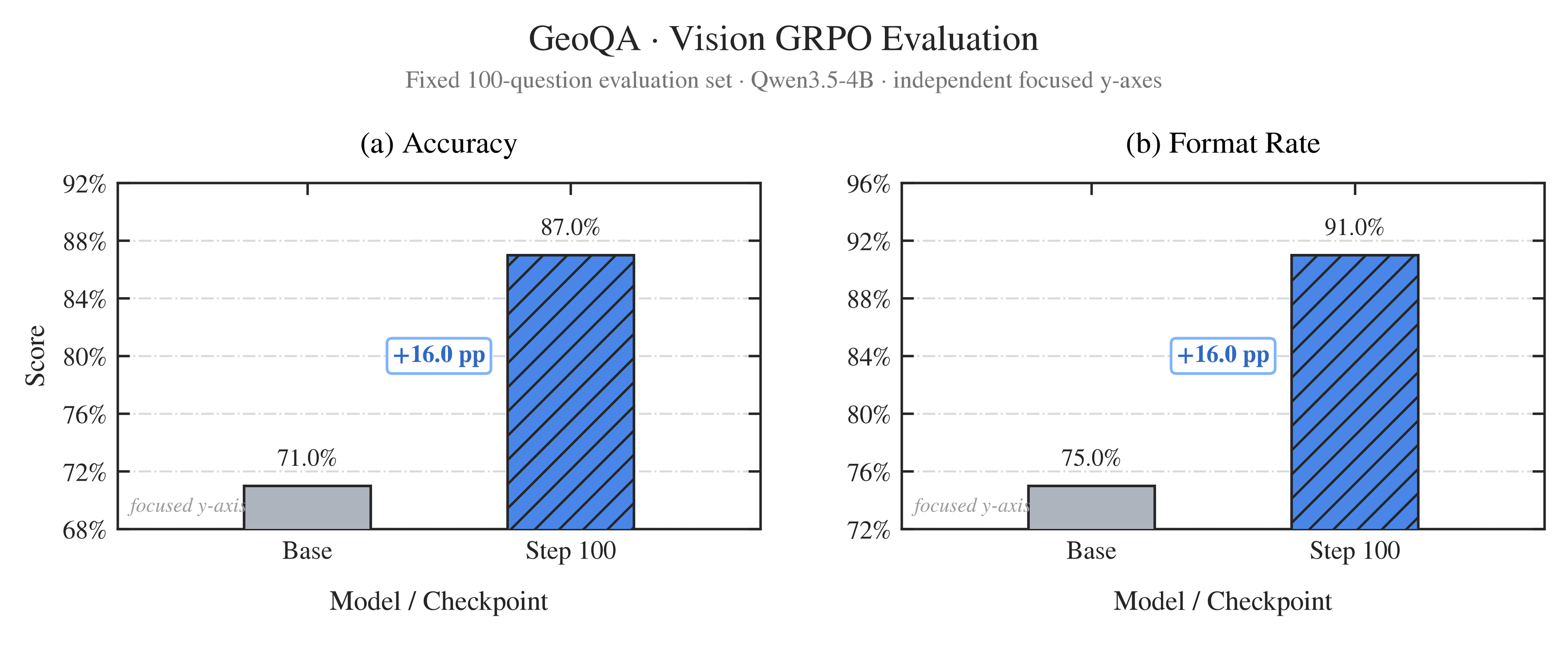
Qwen/Qwen3.5-4Bbase model reached 71.0% accuracy / 75.0% format rate, while the Vision GRPO step-100 checkpoint reached 87.0% / 91.0%.

Introduction
Vision GRPO extends GRPO's group-relative policy update to image inputs. This example uses Chinese geometry multiple-choice problems from GeoQA: the model reads a question, four choices, and a geometry image, performs brief reasoning, and returns \boxed{A}, \boxed{B}, \boxed{C}, or \boxed{D}.
For each question, the current LoRA policy samples a group of responses. A rule-based reward checks the final choice, and the within-group mean defines the advantage:
One training step follows this data flow:
GeoQA question + four choices + image
→ multimodal chat template
→ same-question group rollout
→ boxed-choice reward
→ group-relative advantage
→ multimodal Datum
→ importance_sampling
→ LoRA update
The image and question tokens provide context for the completion. Their targets, old logprobs, and advantages are all zero-padded, so the policy update applies only to tokens generated by the model.
Configuration
| Item | Configuration |
|---|---|
| Base model | Qwen/Qwen3.5-4B |
| PyTRIO | 0.2.7 |
| LoRA rank | 32 |
| Training data | All 3,503 rows from the original GeoQA train split |
| Fixed evaluation set | 100 rows fixed from the original GeoQA test split with seed=42 |
| Reference training run | 100 steps |
| Questions per step | 8 |
| Completions per question | 8 |
| Maximum completion | 1,024 tokens |
| Thinking mode | enable_thinking=False |
| Reward | 1 for the correct \boxed{A-D} choice; 0 otherwise |
| Advantage | reward - group_mean |
| Loss | importance_sampling |
| Learning rate | 4e-5 |
| Checkpointing | Sampler weights + training state every 25 steps |
Project layout
Vision GRPO consists of three scripts:
vision-grpo/
├── download-dataset.py   # Download GeoQA and create train/fixed-test files
├── train.py              # Multimodal rollouts, rewards, GRPO updates, checkpoints
└── eval.py               # Async fixed-set evaluation for one base/checkpoint model
The following sections first explain the code that defines multimodal input construction, GRPO alignment, and asynchronous API boundaries, then provide all three complete scripts.
Environment and data
The local machine prepares images, controls the training loop, and records the experiment. Multimodal sampling, LoRA forward/backward, and parameter updates run on the PyTRIO service.
Use Python 3.13 or later, create an empty directory, and install the required dependencies:
mkdir vision-grpo
cd vision-grpo

python -m venv .venv
source .venv/bin/activate
python -m pip install \
  "pytrio==0.2.7" \
  "datasets>=5.0.0" \
  huggingface_hub numpy pillow swanlab tqdm transformers \
  torch torchvision

trio login
swanlab login
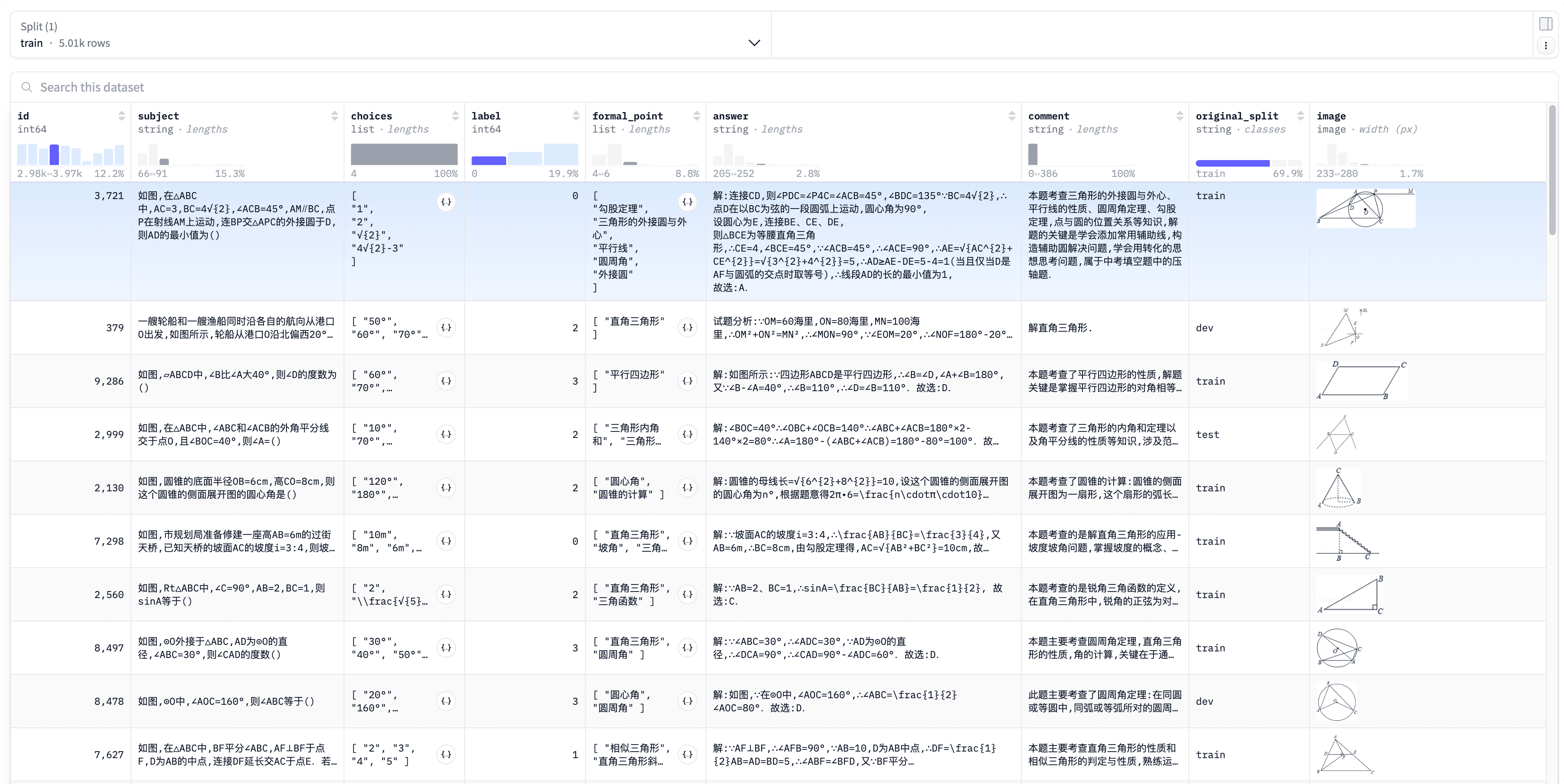
GeoQA contains 5,010 rows: 3,503 train, 759 test, and 748 dev examples in the original split. Each record contains a question, four choices, a label, geometry concepts, an explanation, and an image.
Core logic
1. Split the chat template into multimodal chunks
train.py first renders a message containing an image placeholder with the model's chat template. It then splits the result around <|image_pad|> into:
EncodedTextChunk + ImageChunk + EncodedTextChunkdef build_prompt_chunks(
tokenizer,
image_processor,
image,
subject,
choices,
):
messages = [
{
"role": "user",
"content": [
{"type": "text", "text": format_question(subject, choices)},
{"type": "image", "image": "geoqa"},
],
}
]
prompt = tokenizer.apply_chat_template(
messages,
tokenize=False,
add_generation_prompt=True,
enable_thinking=False,
)
before_image, after_image = prompt.split("<|image_pad|>")
return [
trio.types.EncodedTextChunk(
tokens=tokenizer.encode(before_image, add_special_tokens=False)
),
encode_image(image, image_processor),
trio.types.EncodedTextChunk(
tokens=tokenizer.encode(after_image, add_special_tokens=False)
),
]Transparent image regions are composited onto a white background before RGB conversion. encode_image() uses the image processor to calculate the number of visual patches and stores the visual-token count in ImageChunk.expected_tokens:
patches = image_processor.get_number_of_image_patches(
    image.height,
    image.width,
    images_kwargs={},
)
expected_tokens = patches // int(image_processor.merge_size) ** 2

image_chunk = trio.ImageChunk(
    data=buffer.getvalue(),
    format=chunk_format,
    expected_tokens=expected_tokens,
)
expected_tokens contributes to local sequence-length accounting. After each rollout, the script also compares len(ModelInput) with the remote response.input_tokens value to catch text/image token-count misalignment.
2. Sample a same-question group asynchronously
All eight questions in a step share one sampler snapshot of the current policy, while separate questions run concurrently through tqdm_asyncio.gather(). Each question samples eight completions in one request:
prompt = trio.ModelInput(chunks=prompt_chunks)
prompt_length = len(prompt)

response = await sampling_client.sample_async(
    prompt=prompt,
    num_samples=group_size,
    sampling_params=sampling_params,
    return_text=True,
)

if response.input_tokens != prompt_length:
    raise ValueError(
        "Multimodal prompt length mismatch: "
        f"local={prompt_length}, remote={response.input_tokens}"
    )
The reward reads only the last valid boxed choice:
BOXED_CHOICE_PATTERN = re.compile(
    r"\\boxed\s*\{\s*([A-D])\s*\}",
    re.IGNORECASE,
)

predicted_choice = extract_choice(text)
reward = float(predicted_choice == gold_choice)
mean_reward = sum(rewards) / len(rewards)
advantage = reward - mean_reward| Response result | Reward |
|---|---|
Last \boxed{A-D} matches the label | 1.0 |
| Wrong choice, invalid format, or no boxed choice | 0.0 |
If every reward in a group is 0 or every reward is 1, all advantages are zero and the script skips the group. degenerate_fraction tracks the share of questions without a within-group relative signal.
3. Align image context with the completion loss
Multimodal GRPO still applies the standard autoregressive shift. model_input contains the full multimodal prompt plus completion[:-1], and the other arrays receive zeros over all prompt and image positions:
| Field | Prompt / image interval | Completion interval |
|---|---|---|
model_input | Complete multimodal chunks | completion[:-1] |
target_tokens | 0 placeholder | Full completion tokens |
logprobs | 0.0 placeholder | Old logprobs from the rollout |
advantages | 0.0 placeholder | Group-relative advantage for this completion |
The corresponding Datum construction is:
def build_grpo_datum(group, sample):
    model_input = trio.ModelInput(
        chunks=[
            *group.prompt_chunks,
            trio.types.EncodedTextChunk(tokens=sample.tokens[:-1]),
        ]
    )
    observation_length = group.prompt_length - 1
    return trio.Datum(
        model_input=model_input,
        loss_fn_inputs={
            "target_tokens": np.asarray(
                [0] * observation_length + sample.tokens,
                dtype=np.int64,
            ),
            "logprobs": np.asarray(
                [0.0] * observation_length + sample.logprobs,
                dtype=np.float32,
            ),
            "advantages": np.asarray(
                [0.0] * observation_length
                + [sample.advantage] * len(sample.tokens),
                dtype=np.float32,
            ),
        },
    )
Completion tokens, rollout-time old logprobs, and advantages must have exactly the same length. The old logprobs come from the sampler that generated the trajectory and are never replaced by values recomputed after an update.
4. Update the LoRA after all rollouts finish
At the beginning of every step, the code saves the current LoRA weights and creates the corresponding sampler:
sampling_client = (
    await training_client.save_weights_and_get_sampling_client_async()
)
After all questions complete group rollout, reward, and advantage calculation, the non-degenerate completions enter one policy update:
forward_backward = await training_client.forward_backward_async(
    datums,
    loss_fn="importance_sampling",
)
optim_step = await training_client.optim_step_async(
    trio.AdamParams(learning_rate=args.learning_rate)
)

result = await forward_backward
await optim_step
Two asynchronous return boundaries matter here:
- one
awaitonsample_async()returns the sampling response directly; - the first
awaitonforward_backward_async()oroptim_step_async()returns a remote future, which must be awaited again for completion.
Each checkpoint writes:
*-sampler   # Weights for sampling and evaluation
*-state     # Full training state for resuming
Complete code
Save the following three files in the same directory. eval.py imports the multimodal prompt and answer-parsing helpers from train.py.
download-dataset.py: Download and fix the dataset split
"""下载 GeoQA 数据集到当前案例的 datasets 目录。

运行:
    python download-dataset.py
"""

from __future__ import annotations

import argparse
from pathlib import Path
from tempfile import TemporaryDirectory

from datasets import load_dataset
from huggingface_hub import snapshot_download

DATASET_ID = "hz2475/geoQA"
DEFAULT_OUTPUT_DIR = Path(__file__).resolve().parent / "datasets"
TEST_SEED = 42
TEST_SIZE = 100


def parse_args() -> argparse.Namespace:
    parser = argparse.ArgumentParser(description="下载 GeoQA 数据集")
    parser.add_argument("--dataset-id", default=DATASET_ID)
    parser.add_argument("--output-dir", type=Path, default=DEFAULT_OUTPUT_DIR)
    parser.add_argument("--revision", default="main")
    parser.add_argument("--force", action="store_true", help="强制重新下载")
    return parser.parse_args()


def main() -> None:
    args = parse_args()
    output_dir = args.output_dir.expanduser().resolve()
    output_dir.mkdir(parents=True, exist_ok=True)

    with TemporaryDirectory(prefix="geoqa-") as download_dir:
        snapshot_download(
            repo_id=args.dataset_id,
            repo_type="dataset",
            revision=args.revision,
            local_dir=download_dir,
            allow_patterns=["data/*.parquet"],
            force_download=args.force,
        )
        parquet_files = sorted((Path(download_dir) / "data").glob("*.parquet"))
        dataset = load_dataset(
            "parquet",
            data_files={"train": [str(path) for path in parquet_files]},
            split="train",
        )

        train_data = dataset.filter(
            lambda split: split == "train",
            input_columns=["original_split"],
            desc="提取 GeoQA train",
        ).remove_columns("original_split")
        test_data = dataset.filter(
            lambda split: split == "test",
            input_columns=["original_split"],
            desc="提取 GeoQA test",
        ).shuffle(seed=TEST_SEED)
        test_data = test_data.select(
            range(len(test_data) - TEST_SIZE, len(test_data))
        ).remove_columns("original_split")

        train_path = output_dir / "train.parquet"
        test_path = output_dir / "test.parquet"
        train_data.to_parquet(train_path)
        test_data.to_parquet(test_path)

    print(f"dataset_dir={output_dir}")
    print(f"train_file={train_path} rows={len(train_data)}")
    print(f"test_file={test_path} rows={len(test_data)}")


if __name__ == "__main__":
    main()
train.py: Run Vision GRPO training
"""使用 PyTRIO 在 GeoQA 上运行多模态 GRPO。

准备数据:
python download-dataset.py

小规模测试:
python train.py \
    --steps 20 \
    --batch-size 8 \
    --group-size 8 \
    --max-tokens 1024 \
    --save-every 10 \
    --swanlab-mode disabled
"""

from __future__ import annotations

import argparse
import asyncio
import io
import re
import time
from dataclasses import dataclass
from importlib.metadata import version
from pathlib import Path
from typing import Any

import numpy as np
import pytrio as trio
import swanlab
from datasets import Dataset, load_dataset
from PIL import Image
from tqdm.asyncio import tqdm_asyncio
from transformers import AutoImageProcessor

SCRIPT_DIR = Path(__file__).resolve().parent
DEFAULT_DATASET_DIR = SCRIPT_DIR / "datasets"
DEFAULT_MODEL = "Qwen/Qwen3.5-4B"
IMAGE_PAD_TOKEN = "<|image_pad|>"
CHOICE_LETTERS = "ABCD"
BOXED_CHOICE_PATTERN = re.compile(r"\\boxed\s*\{\s*([A-D])\s*\}", re.IGNORECASE)


@dataclass(frozen=True)
class RolloutSample:
    tokens: list[int]
    logprobs: list[float]
    text: str
    predicted_choice: str | None
    reward: float
    advantage: float


@dataclass(frozen=True)
class RolloutGroup:
    prompt_chunks: list[Any]
    prompt_length: int
    samples: list[RolloutSample]


def parse_args() -> argparse.Namespace:
    parser = argparse.ArgumentParser(description="GeoQA 多模态 GRPO")
    parser.add_argument("--dataset-dir", type=Path, default=DEFAULT_DATASET_DIR)
    parser.add_argument("--base-model", default=DEFAULT_MODEL)
    parser.add_argument("--lora-rank", type=int, default=32)
    parser.add_argument("--steps", type=int, default=10)
    parser.add_argument("--batch-size", type=int, default=4)
    parser.add_argument("--group-size", type=int, default=4)
    parser.add_argument(
        "--max-samples", type=int, default=0, help="0 表示使用全部训练集"
    )
    parser.add_argument("--max-tokens", type=int, default=64)
    parser.add_argument("--temperature", type=float, default=1.0)
    parser.add_argument("--top-p", type=float, default=1.0)
    parser.add_argument("--seed", type=int, default=42)
    parser.add_argument("--learning-rate", type=float, default=4e-5)
    parser.add_argument(
        "--swanlab-mode",
        choices=("online", "local", "offline", "disabled"),
        default="online",
    )
    parser.add_argument("--swanlab-project", default="vision-grpo")
    parser.add_argument(
        "--experiment-name",
        default="vision-grpo-qwen35-4b-geoqa",
    )
    parser.add_argument(
        "--weights-name",
        default="vision-grpo-qwen35-4b-geoqa",
    )
    parser.add_argument(
        "--save-every",
        type=int,
        default=10,
        help="每隔多少个 step 保存一次,0 表示只保存最终 checkpoint",
    )
    parser.add_argument(
        "--save-weights",
        action=argparse.BooleanOptionalAction,
        default=True,
    )
    parser.add_argument("--show-samples", action="store_true")
    return parser.parse_args()


def load_geoqa_train(dataset_dir: Path, seed: int, max_samples: int) -> Dataset:
    """读取并打乱训练数据。"""
    dataset = load_dataset(
        "parquet",
        data_files=str(dataset_dir / "train.parquet"),
        split="train",
    ).shuffle(seed=seed)
    if max_samples > 0:
        dataset = dataset.select(range(min(max_samples, len(dataset))))
    return dataset


def pick_batch(dataset: Dataset, step: int, batch_size: int) -> Dataset:
    """按 step 顺序取 batch,走完数据后从头继续。"""
    start = step * batch_size
    indices = [(start + offset) % len(dataset) for offset in range(batch_size)]
    return dataset.select(indices)


def encode_image(image: Image.Image, image_processor: Any) -> trio.ImageChunk:
    """将图片编码成 PyTRIO chunk,并计算视觉 token 数。"""
    chunk_format = "jpeg" if image.format in {"JPG", "JPEG"} else "png"
    rgba = image.convert("RGBA")
    background = Image.new("RGBA", rgba.size, (255, 255, 255, 255))
    image = Image.alpha_composite(background, rgba).convert("RGB")

    buffer = io.BytesIO()
    image.save(buffer, format=chunk_format.upper())
    patches = image_processor.get_number_of_image_patches(
        image.height,
        image.width,
        images_kwargs={},
    )
    expected_tokens = patches // int(image_processor.merge_size) ** 2
    return trio.ImageChunk(
        data=buffer.getvalue(),
        format=chunk_format,
        expected_tokens=expected_tokens,
    )


def format_question(subject: str, choices: list[str]) -> str:
    """将题目和四个选项整理成模型指令。"""
    choice_lines = "\n".join(
        f"{letter}. {choice}"
        for letter, choice in zip(CHOICE_LETTERS, choices, strict=True)
    )
    return (
        "请根据图片解答下面的几何选择题。\n"
        f"题目:{subject.strip()}\n"
        f"选项:\n{choice_lines}\n"
        "请先进行简单逻辑推理思考,再给出最终答案。"
        "最终选项格式必须是 \\boxed{A}、\\boxed{B}、\\boxed{C} 或 \\boxed{D}。"
    )


def build_prompt_chunks(
    tokenizer: Any,
    image_processor: Any,
    image: Image.Image,
    subject: str,
    choices: list[str],
) -> list[Any]:
    """先用 chat template 格式化 messages,再拆成图文 chunks。"""
    messages = [
        {
            "role": "user",
            "content": [
                {"type": "text", "text": format_question(subject, choices)},
                {"type": "image", "image": "geoqa"},
            ],
        }
    ]
    prompt = tokenizer.apply_chat_template(
        messages,
        tokenize=False,
        add_generation_prompt=True,
        enable_thinking=False,
    )
    before_image, after_image = prompt.split(IMAGE_PAD_TOKEN)
    return [
        trio.types.EncodedTextChunk(
            tokens=tokenizer.encode(before_image, add_special_tokens=False)
        ),
        encode_image(image, image_processor),
        trio.types.EncodedTextChunk(
            tokens=tokenizer.encode(after_image, add_special_tokens=False)
        ),
    ]


def extract_choice(text: str) -> str | None:
    """提取回答中最后一个 boxed 选项。"""
    matches = BOXED_CHOICE_PATTERN.findall(text)
    return matches[-1].upper() if matches else None


async def run_rollout_group(
    sampling_client: Any,
    tokenizer: Any,
    prompt_chunks: list[Any],
    gold_choice: str,
    sampling_params: trio.SamplingParams,
    group_size: int,
) -> RolloutGroup:
    """异步采样同一道题的一组回答,并计算组内 advantage。"""
    prompt = trio.ModelInput(chunks=prompt_chunks)
    prompt_length = len(prompt)
    response = await sampling_client.sample_async(
        prompt=prompt,
        num_samples=group_size,
        sampling_params=sampling_params,
        return_text=True,
    )
    if response.input_tokens != prompt_length:
        raise ValueError(
            f"图文 prompt 长度不一致:local={prompt_length}, remote={response.input_tokens}"
        )

    raw_samples: list[tuple[list[int], list[float], str, str | None, float]] = []
    rewards: list[float] = []
    for sequence in response.sequences:
        tokens = list(sequence.tokens)
        logprobs = [float(value) for value in sequence.logprobs]
        if len(tokens) != len(logprobs):
            raise ValueError("生成 token 与 logprob 长度不一致")
        text = sequence.text or tokenizer.decode(tokens, skip_special_tokens=True)
        predicted_choice = extract_choice(text)
        reward = float(predicted_choice == gold_choice)
        rewards.append(reward)
        raw_samples.append((tokens, logprobs, text, predicted_choice, reward))

    mean_reward = sum(rewards) / len(rewards)
    samples = [
        RolloutSample(
            tokens=tokens,
            logprobs=logprobs,
            text=text,
            predicted_choice=predicted_choice,
            reward=reward,
            advantage=reward - mean_reward,
        )
        for tokens, logprobs, text, predicted_choice, reward in raw_samples
    ]
    return RolloutGroup(prompt_chunks, prompt_length, samples)


def build_grpo_datum(group: RolloutGroup, sample: RolloutSample) -> trio.Datum:
    """把图文 prompt chunk 和 completion 拼成 GRPO Datum。"""
    model_input = trio.ModelInput(
        chunks=[
            *group.prompt_chunks,
            trio.types.EncodedTextChunk(tokens=sample.tokens[:-1]),
        ]
    )
    observation_length = group.prompt_length - 1
    return trio.Datum(
        model_input=model_input,
        loss_fn_inputs={
            "target_tokens": np.asarray(
                [0] * observation_length + sample.tokens,
                dtype=np.int64,
            ),
            "logprobs": np.asarray(
                [0.0] * observation_length + sample.logprobs,
                dtype=np.float32,
            ),
            "advantages": np.asarray(
                [0.0] * observation_length + [sample.advantage] * len(sample.tokens),
                dtype=np.float32,
            ),
        },
    )


def init_swanlab(args: argparse.Namespace, dataset_size: int) -> Any:
    """初始化训练日志。"""
    return swanlab.init(
        mode=args.swanlab_mode,
        project=args.swanlab_project,
        experiment_name=args.experiment_name,
        config={
            "algorithm": "vision-grpo",
            "dataset": "hz2475/geoQA",
            "dataset_size": dataset_size,
            "base_model": args.base_model,
            "pytrio_version": version("pytrio"),
            "enable_thinking": False,
            "lora_rank": args.lora_rank,
            "steps": args.steps,
            "batch_size": args.batch_size,
            "group_size": args.group_size,
            "max_tokens": args.max_tokens,
            "temperature": args.temperature,
            "learning_rate": args.learning_rate,
            "save_every": args.save_every,
        },
    )


async def save_checkpoint(
    training_client: trio.TrainingClient,
    weights_name: str,
    step: int,
) -> None:
    """同时保存推理权重和完整训练状态。"""
    prefix = f"{weights_name}-step-{step}"
    sampler_future = await training_client.save_weights_for_sampler_async(
        name=f"{prefix}-sampler"
    )
    state_future = await training_client.save_state_async(name=f"{prefix}-state")
    sampler_weights, training_state = await asyncio.gather(
        sampler_future,
        state_future,
    )
    print(f"Sampler 权重:{sampler_weights.path}")
    print(f"State 权重:{training_state.path}")


async def main(args: argparse.Namespace) -> None:
    train_data = load_geoqa_train(
        args.dataset_dir.expanduser().resolve(),
        args.seed,
        args.max_samples,
    )
    print(f"加载 GeoQA train 数据:{len(train_data)} 条")
    print(f"PyTRIO:{version('pytrio')}")

    service_client = trio.ServiceClient()
    training_client = await service_client.create_lora_training_client_async(
        base_model=args.base_model,
        rank=args.lora_rank,
        seed=args.seed,
    )
    tokenizer = training_client.get_tokenizer()
    image_processor = AutoImageProcessor.from_pretrained(
        args.base_model,
        use_fast=False,
    )
    sampling_params = trio.SamplingParams(
        max_tokens=args.max_tokens,
        temperature=args.temperature,
        top_p=args.top_p,
        stop="<|im_end|>",
    )
    adam_params = trio.AdamParams(learning_rate=args.learning_rate)
    swanlab_run = init_swanlab(args, len(train_data))
    last_saved_step = 0

    try:
        for step in range(args.steps):
            batch_rows = list(pick_batch(train_data, step, args.batch_size))
            sampling_client = (
                await training_client.save_weights_and_get_sampling_client_async()
            )
            datums: list[trio.Datum] = []
            all_samples: list[RolloutSample] = []
            prompt_rewards: list[float] = []
            degenerate_groups = 0

            # 一个 step 内的不同题目使用同一版 sampler 并发 rollout。
            rollout_groups = await tqdm_asyncio.gather(
                *(
                    run_rollout_group(
                        sampling_client,
                        tokenizer,
                        build_prompt_chunks(
                            tokenizer,
                            image_processor,
                            row["image"],
                            str(row["subject"]),
                            [str(choice) for choice in row["choices"]],
                        ),
                        CHOICE_LETTERS[int(row["label"])],
                        sampling_params,
                        args.group_size,
                    )
                    for row in batch_rows
                ),
                desc=f"Step {step + 1}/{args.steps} rollout",
                unit="题",
            )

            for row, group in zip(batch_rows, rollout_groups, strict=True):
                gold_choice = CHOICE_LETTERS[int(row["label"])]
                all_samples.extend(group.samples)
                rewards = [sample.reward for sample in group.samples]
                prompt_rewards.append(sum(rewards) / len(rewards))

                if args.show_samples:
                    print(f"\nGeoQA id={row['id']} gold={gold_choice}")
                    for index, sample in enumerate(group.samples):
                        print(
                            f"  sample={index} predicted={sample.predicted_choice} "
                            f"reward={sample.reward:.0f} text={sample.text!r}"
                        )

                # 整组 reward 相同时没有相对优势,不参与更新。
                if len(set(rewards)) == 1:
                    degenerate_groups += 1
                    continue
                datums.extend(
                    build_grpo_datum(group, sample)
                    for sample in group.samples
                    if sample.tokens
                )

            mean_output_tokens = sum(
                len(sample.tokens) for sample in all_samples
            ) / len(all_samples)
            tqdm_asyncio.write(
                f"本 batch 平均输出长度:{mean_output_tokens:.1f} tokens"
            )

            trainer_metrics: dict[str, float] = {}
            if datums:
                forward_backward = await training_client.forward_backward_async(
                    datums,
                    loss_fn="importance_sampling",
                )
                optim_step = await training_client.optim_step_async(adam_params)
                result = await forward_backward
                await optim_step
                trainer_metrics = {
                    key: float(value) for key, value in result.metrics.items()
                }

            mean_reward = sum(prompt_rewards) / len(prompt_rewards)
            format_rate = sum(
                sample.predicted_choice is not None for sample in all_samples
            ) / len(all_samples)
            degenerate_fraction = degenerate_groups / len(prompt_rewards)
            metrics = {
                "reward": mean_reward,
                "format_rate": format_rate,
                "degenerate_fraction": degenerate_fraction,
                "train_datums": len(datums),
                "rollout/completion_tokens_mean": mean_output_tokens,
                **{f"trainer/{key}": value for key, value in trainer_metrics.items()},
            }
            swanlab.log(metrics, step=step)

            loss_mean = trainer_metrics.get("loss_mean")
            loss_text = "n/a" if loss_mean is None else f"{loss_mean:.4f}"
            print(
                f"Step {step + 1}/{args.steps} | reward={mean_reward:.3f} | "
                f"format={format_rate:.1%} | degenerate={degenerate_fraction:.1%} | "
                f"datums={len(datums)} | loss_mean={loss_text}",
                flush=True,
            )

            current_step = step + 1
            if (
                args.save_weights
                and args.save_every > 0
                and current_step % args.save_every == 0
            ):
                await save_checkpoint(training_client, args.weights_name, current_step)
                last_saved_step = current_step

        if args.save_weights and last_saved_step != args.steps:
            await save_checkpoint(training_client, args.weights_name, args.steps)
    finally:
        swanlab_run.finish()


if __name__ == "__main__":
    start_time = time.perf_counter()
    asyncio.run(main(parse_args()))
    print(f"训练耗时:{time.perf_counter() - start_time:.2f}s")
eval.py: Evaluate one model asynchronously
"""在固定的 100 条 GeoQA test 样本上评测单个模型。

评测 Base:
python eval.py

评测训练后模型:
python eval.py \
    --model-path trio://run_xxx/sampler_weights/xxx-step-100-sampler
"""

from __future__ import annotations

import argparse
import asyncio
import json
import time
from pathlib import Path
from typing import Any

import pytrio as trio
from datasets import Dataset, load_dataset
from tqdm.asyncio import tqdm_asyncio
from transformers import AutoImageProcessor

from train import (
    CHOICE_LETTERS,
    DEFAULT_DATASET_DIR,
    DEFAULT_MODEL,
    build_prompt_chunks,
    extract_choice,
)

SCRIPT_DIR = Path(__file__).resolve().parent
EVAL_SEED = 42
EVAL_SIZE = 100
DEFAULT_OUTPUT = SCRIPT_DIR / "eval-results.json"


def parse_args() -> argparse.Namespace:
    parser = argparse.ArgumentParser(description="评测 GeoQA 多模态 GRPO")
    parser.add_argument("--dataset-dir", type=Path, default=DEFAULT_DATASET_DIR)
    parser.add_argument("--base-model", default=DEFAULT_MODEL)
    parser.add_argument(
        "--model-path",
        help="训练脚本输出的 Sampler 权重路径,不传则评测 Base 模型",
    )
    parser.add_argument("--max-tokens", type=int, default=1024)
    parser.add_argument(
        "--limit",
        type=int,
        default=EVAL_SIZE,
        help="默认评测固定的 100 条;调试时可缩小",
    )
    parser.add_argument("--output", type=Path, default=DEFAULT_OUTPUT)
    return parser.parse_args()


def load_eval_data(dataset_dir: Path, limit: int) -> Dataset:
    """读取下载阶段固定的 100 条测试数据。"""
    dataset = load_dataset(
        "parquet",
        data_files=str(dataset_dir / "test.parquet"),
        split="train",
    )
    return dataset.select(range(min(limit, len(dataset))))


def parse_response(response: Any, tokenizer: Any) -> tuple[str, str | None]:
    """读取单条采样结果中的文本和选项。"""
    sequence = response.sequences[0]
    text = sequence.text or tokenizer.decode(sequence.tokens, skip_special_tokens=True)
    return text, extract_choice(text)


async def main(args: argparse.Namespace) -> None:
    eval_data = load_eval_data(args.dataset_dir.expanduser().resolve(), args.limit)
    service_client = trio.ServiceClient()
    sampling_client = await service_client.create_sampling_client_async(
        base_model=args.base_model,
        model_path=args.model_path,
    )
    tokenizer = sampling_client.get_tokenizer()
    image_processor = AutoImageProcessor.from_pretrained(
        args.base_model,
        use_fast=False,
    )
    sampling_params = trio.SamplingParams(
        max_tokens=args.max_tokens,
        seed=EVAL_SEED,
        temperature=0.0,
        stop="<|im_end|>",
    )

    async def evaluate_row(row: dict[str, Any]) -> dict[str, Any]:
        choices = [str(choice) for choice in row["choices"]]
        gold_choice = CHOICE_LETTERS[int(row["label"])]
        prompt = trio.ModelInput(
            chunks=build_prompt_chunks(
                tokenizer,
                image_processor,
                row["image"],
                str(row["subject"]),
                choices,
            )
        )
        response = await sampling_client.sample_async(
            prompt=prompt,
            num_samples=1,
            sampling_params=sampling_params,
            return_text=True,
        )
        text, predicted_choice = parse_response(response, tokenizer)
        return {
            "id": int(row["id"]),
            "gold": gold_choice,
            "prediction": predicted_choice,
            "text": text,
        }

    # 固定测试集共享同一个 sampler 并发评测。
    results = await tqdm_asyncio.gather(
        *(evaluate_row(row) for row in eval_data),
        desc="评测 GeoQA",
        unit="sample",
    )

    total = len(results)
    correct = sum(result["prediction"] == result["gold"] for result in results)
    formatted = sum(result["prediction"] is not None for result in results)
    metrics = {
        "accuracy": correct / total,
        "format_rate": formatted / total,
    }
    output = args.output.expanduser().resolve()
    output.write_text(
        json.dumps(
            {
                "base_model": args.base_model,
                "model_path": args.model_path,
                "eval_seed": EVAL_SEED,
                "eval_size": total,
                "metrics": metrics,
                "samples": results,
            },
            ensure_ascii=False,
            indent=2,
        ),
        encoding="utf-8",
    )

    print(f"模型:{args.model_path or args.base_model}")
    print(f"Accuracy:{metrics['accuracy']:.1%}")
    print(f"Format rate:{metrics['format_rate']:.1%}")
    print(f"评测结果:{output}")


if __name__ == "__main__":
    start_time = time.perf_counter()
    asyncio.run(main(parse_args()))
    print(f"评测耗时:{time.perf_counter() - start_time:.2f}s")
Run training
Start with 20 steps to validate data preparation, multimodal sampling, reward calculation, training, and checkpointing end to end:
python train.py \
  --steps 20 \
  --batch-size 8 \
  --group-size 8 \
  --max-tokens 1024 \
  --save-every 10 \
  --swanlab-mode online
Run the step-100 configuration used on this page:
python train.py \
  --steps 100 \
  --batch-size 8 \
  --group-size 8 \
  --max-tokens 1024 \
  --save-every 25 \
  --swanlab-mode online
The reward and format_rate curves from the small 20-step session are shown below. These metrics describe each online training batch and vary with question difficulty and sampling; the fixed test set measures before/after behavior on the same questions.
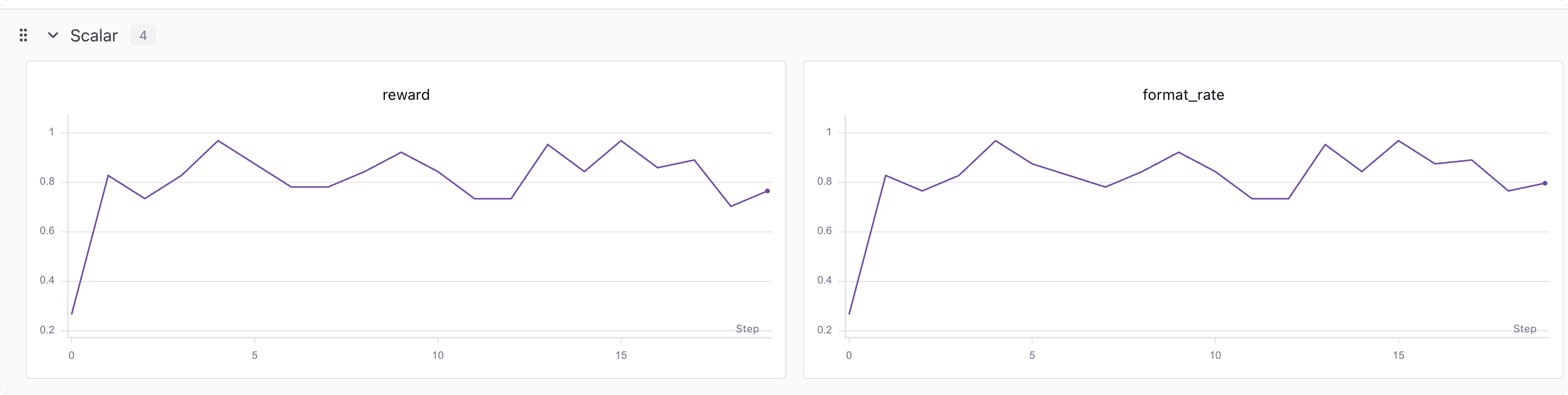
Monitor the following training metrics:
| Metric | What it checks |
|---|---|
reward | Mean rule-based reward across questions in the current batch |
format_rate | Share of completions with a parseable \boxed{A-D} |
degenerate_fraction | Share of questions without a within-group relative signal |
train_datums | Completions that actually enter forward_backward |
rollout/completion_tokens_mean | Mean generation length in the current batch |
trainer/* | Training metrics returned by the PyTRIO service |
Fixed-set evaluation
eval.py creates exactly one sampler per run. Omitting --model-path evaluates the base model; passing one trio://... path evaluates that LoRA checkpoint.
Evaluate the base model:
python eval.py \
  --output eval-results-base.json
Evaluate the step-100 sampler weights:
python eval.py \
  --model-path 'trio://YOUR_STEP_100_SAMPLER_WEIGHTS' \
  --output eval-results-step-100.json
All 100 questions in one run share that sampler and execute concurrently with sample_async():
sampling_client = await service_client.create_sampling_client_async(
    base_model=args.base_model,
    model_path=args.model_path,
)

results = await tqdm_asyncio.gather(
    *(evaluate_row(row) for row in eval_data),
    desc="Evaluate GeoQA",
    unit="sample",
)
Evaluation uses temperature=0.0, seed=42, and max_tokens=1024. The measured results are:
| Model | Accuracy | Format rate | Sampling speed | Total time |
|---|---|---|---|---|
| Base | 71.0% | 75.0% | 2.20 sample/s | 48.65s |
| Vision GRPO step 100 | 87.0% | 91.0% | 2.35 sample/s | 49.45s |
| Change | +16.0 pp | +16.0 pp | +0.15 sample/s | +0.80s |
The result counts provide more detail:
- Base: 71 correct, 4 formatted but incorrect, and 25 without a parseable boxed choice;
- step 100: 87 correct, 4 formatted but incorrect, and 9 without a parseable boxed choice;
- accuracy among formatted responses rose from
71 / 75 = 94.7%to87 / 91 = 95.6%.
GRPO
Category: RL; dataset: GSM8K; training tokens 0.132M; prefill tokens 0.1M; sample tokens 0.311M; implementations: sync / async
On-Policy Distillation
Category: RL / distillation; dataset: DeepMath-103K; training tokens 0.982M; prefill tokens 0.996M; sample tokens 0.802M; implementations: sync / async