Spec-o3
Code source and cost
- The complete implementation comes from
datawhalechina/agentic-rl-lab/experiments/spec-o3. This page was checked against commit8630864; the source links and commands below refer to that revision.- The initial
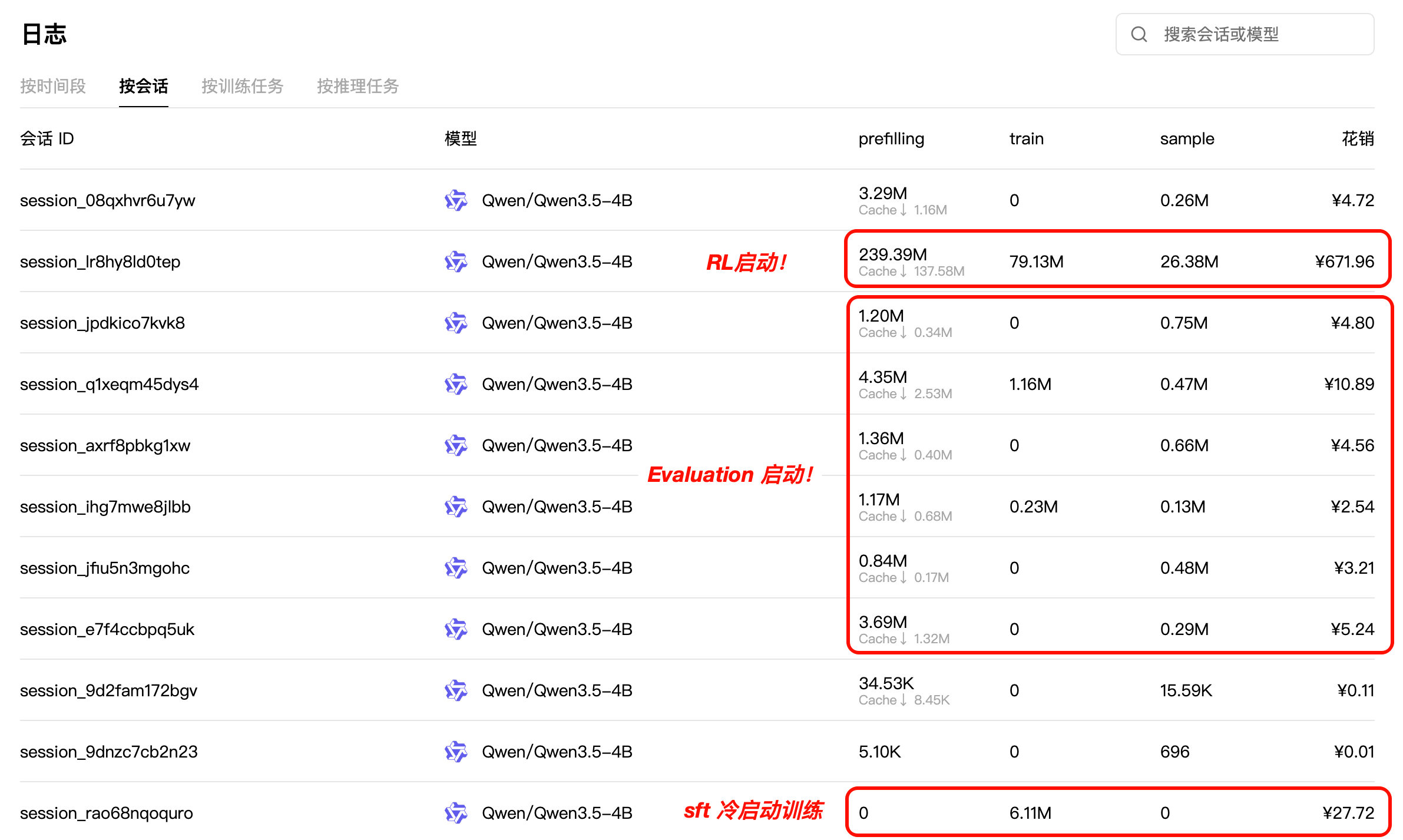
Qwen/Qwen3.5-4Btraining sessions cost ¥699.68 in total: ¥27.72 for Cold-start SFT (2 epochs, 6.11M train tokens) and ¥671.96 for RL epoch 1 (239.39M prefilling / 79.13M train / 26.38M sample tokens). Evaluations, debugging runs, and the follow-up 4B/9B epoch 3 runs are separate. All figures are measured reference runs rather than fixed pricing.- See the SwanLab runs for SFT and RL curves. Because this example combines a custom multimodal template, a local spectral plotting tool, async SFT, and multimodal GRPO, this page covers the core implementation while the source repository remains the runnable reference.
Introduction
Spec-o3 is a multimodal tool-augmented agent for vetting rare celestial object candidates from astronomical spectra. Given a full spectrum image and diagnostic guidelines, the model makes a YES / NO judgment for one of five target classes:
| Task key | Target class |
|---|---|
cv | Cataclysmic Variables |
cc | Carbon Stars |
ss | S-type Stars |
gm | M-type Giants |
wd | White Dwarfs |
Its core mechanism is Interleaved Multimodal Chain-of-Thought (iMCoT): the model reasons over the spectrum, invokes spectral_visualization_tool with a chosen wavelength interval, receives a newly plotted zoomed-in PNG spectrum in context, and repeats until it outputs a final decision:
user question + full spectrum image
→ assistant <think> selects wavelength window to inspect
→ <tool_call> spectral_visualization_tool(wavelength_range, label)
→ local tool plots zoomed spectrum PNG from .npz array
→ <tool_response> appends new image to context
→ assistant continues reasoning or outputs <answer>\boxed{YES|NO}...</answer>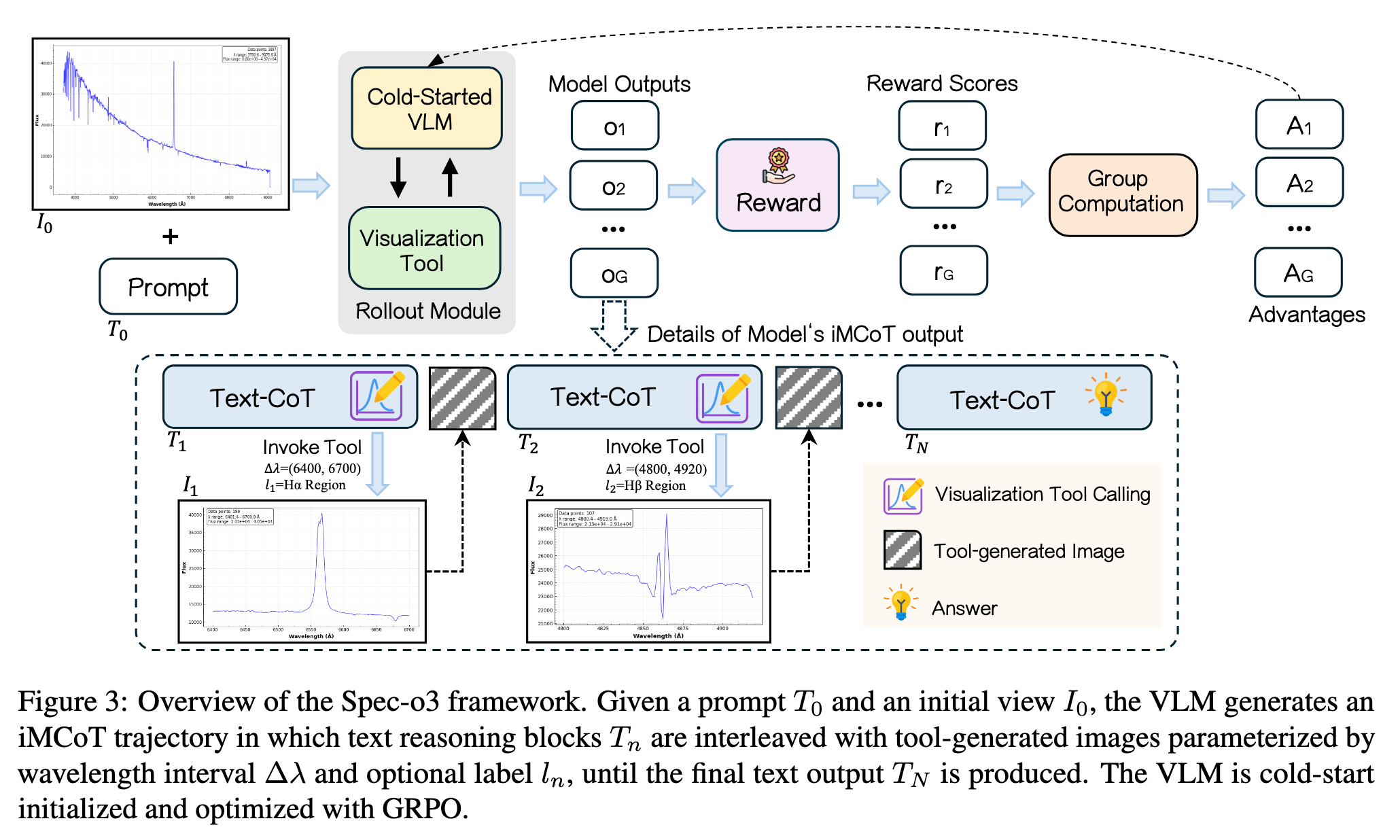
This example adapts the paper's two-stage pipeline (Cold-start SFT → multimodal GRPO) to Qwen/Qwen3.5-4B / Qwen/Qwen3.5-9B LoRA on PyTRIO:
Only the model's LoRA weights are trained. The local spectral plotting tool and its returned text and images remain fixed environment observations with zero loss weight and zero advantage.
Configuration
| Item | Configuration (initial 4B reference / follow-up 4B & 9B) |
|---|---|
| Base model | Qwen/Qwen3.5-4B (follow-up comparison with Qwen/Qwen3.5-9B) |
| Training method | PyTRIO LoRA, rank 32 |
| SFT data | Maxwell-Jia/Spec-o3-ColdStartSFT (848 train / 94 val) |
| RL & eval data | Maxwell-Jia/SpecVI-Bench (3,108 RL train / 256 dev / 6,754 test) |
| SFT settings | 2 epochs (424 steps), batch size 4, Adam lr 2e-5, cross_entropy |
| RL settings | 1 epoch (389 rollout batches; extended to 3 epochs), 8 questions × group 8 = 64 rollouts, Adam lr 1e-6 |
| RL horizon & budgets | Up to 8 turns (up to 7 tool calls), ≤ 2,048 tokens / turn, ≤ 16,384 total context |
| RL reward | 1[correct] - 0.2 × 1[format_error] (no tool-call bonus) |
| RL advantage | Group-standardized (r - mean) / (std(ddof=1) + 1e-6); zero-variance groups skipped |
| RL loss | ppo, clip [0.8, 1.2] |
| Checkpoints | SFT every epoch; RL every 100 rollout steps and epoch end (state + sampler) |
Main differences from the authors' released setup: the paper trains Qwen2.5-VL-3B/7B-Instruct on 8×H100 with full-parameter LLM SFT (5 epochs, cosine schedule), RL batch size 64 × 8 (3 epochs), and 32K context. This reproduction transfers the method to Qwen3.5 LoRA rank 32, constant learning rates, batch size 8, and a 16K context cap.
Project layout
experiments/spec-o3/
├── prepare_data.py                 # Download, clean, split SFT/SpecVI-Bench data and .npz spectra
├── templates/qwen3_5_spec_o3.jinja # Preserves multi-turn reasoning and marks {% generation %} spans
├── protocol.py                     # ImageChunk packing, SFT/RL Datum builders, action parser
├── tools.py                        # Rest-frame redshift correction and zoomed PNG plotting
├── rollout.py                      # Multi-turn multimodal rollout loop preserving tokens & logprobs
├── train_sft.py                    # Async multimodal SFT, validation loss, and checkpoint saving
├── train_rl.py                     # Group rollouts, rewards, standardized advantages, PPO updates
├── eval.py                         # Concurrent 256-sample dev evaluation with full artifacts
├── analysis.py                     # Plot the five-model comparison figure
└── start.md                        # Complete quick-start command sheet
Use the complete source directory to run the example.
Environment and data
Requires Python >=3.13 and pytrio==0.2.9. Data prep, plotting, and orchestration run locally while training and sampling execute remotely on PyTRIO. Run all commands inside experiments/spec-o3/:
git clone https://github.com/datawhalechina/agentic-rl-lab.git
cd agentic-rl-lab
git checkout 8630864d9f007cb871b096b23d7a2242b2260be4

uv sync --locked
cd experiments/spec-o3
uv run trio login
uv run swanlab login
Prepare SFT data first, then RL/benchmark data (bench reads the SFT object list to keep SFT spectra out of the dev split):
uv run python prepare_data.py sft
uv run python prepare_data.py bench
This populates datasets/sft/ (sft_train.jsonl 848 rows, sft_val.jsonl 94 rows) and datasets/rl/ (bench_rl_train.jsonl 3,108 rows, bench_dev.jsonl 256 rows, spectra/*.npz, and initial spectrum PNGs). JSONL files store absolute paths; re-run preparation if moving directories.
Core logic
1. Custom multimodal chat template and ImageChunk packing
qwen3_5_spec_o3.jinja adapts Qwen3.5's chat template in two ways: it preserves reasoning_content across every assistant turn and wraps assistant spans in {% generation %} so the tokenizer emits an exact supervision mask.
pack_chunks() in protocol.py expands each <|image_pad|> token into a trio.ImageChunk sized via the matching image_processor, assigning zero loss weight to every visual token position:
chunk = image_chunk(next(paths), image_processor)
chunks.append(chunk)
targets.extend([0] * chunk.expected_tokens)
weights.extend([0.0] * chunk.expected_tokens)
Subsequent tool-generated plots enter ModelInput through the exact same ImageChunk mechanism.
2. Local spectral zoom tool
tools.py loads wavelength, flux, and redshift from the pre-extracted .npz file, shifts to rest-frame wavelength, slices the requested window, and renders a fresh PNG:
wavelength = np.asarray(wavelength) / (1 + redshift)
low, high = wavelength_range
selected = (wavelength >= low) & (wavelength <= high)
ax.plot(wavelength[selected], flux[selected])
If fewer than two data points fall in the window, the tool returns a text message instead of an image so the model can adjust its range on the next turn.
3. Cold-start SFT to teach the interleaved protocol
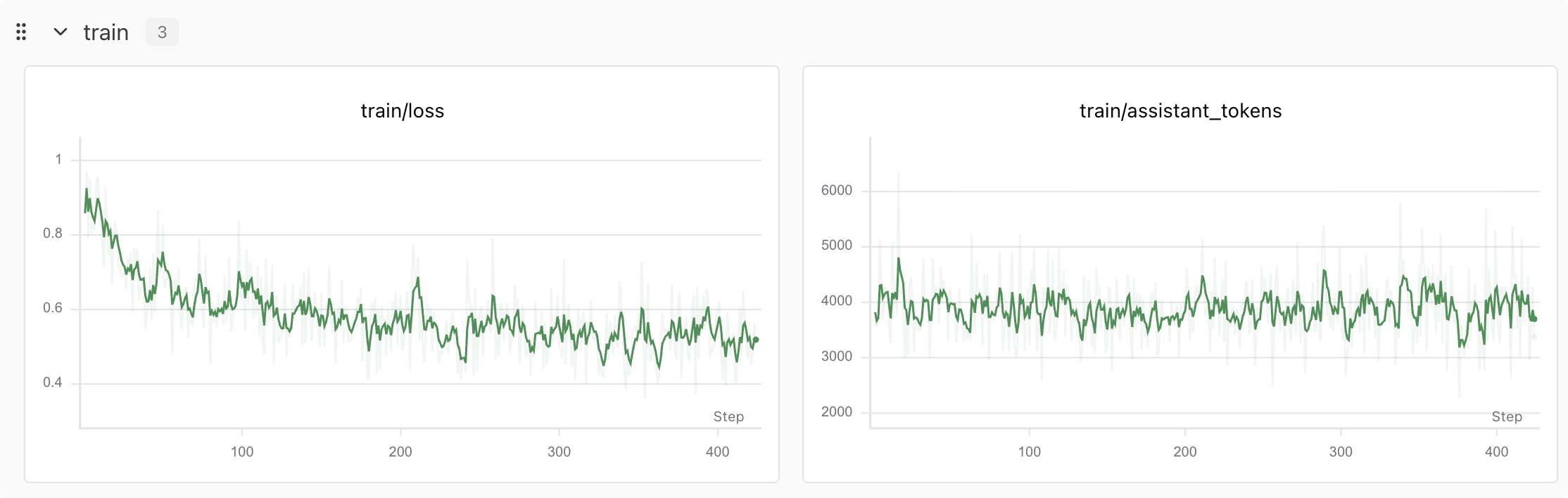
The 4B base model achieves only 0.39% strict format compliance on the dev set, making cold-start SFT essential. train_sft.py runs async cross_entropy training over full demonstration trajectories, supervising only assistant reasoning, tool calls, and answers while normalizing weights by total batch assistant tokens.
4. Multi-turn multimodal rollout and token-in token-out continuation
train_rl.py samples turn 1 with num_samples=8 per question, then rollout.py advances all 8 trajectories concurrently:
- Each turn appends exact sampled
tokensandlogprobswithout re-encoding assistant text; - After plotting a new image,
tool_continuation()encodes only the newly appended<tool_response>and next-turn prefix, fillingtarget_tokens,logprobs, andaction_maskwith zeros; - Trajectories stop on a final answer, invalid action, 8 turns, or the 16,384-token budget.
5. Outcome reward, group-standardized advantage, and PPO update
trajectory_reward() scores only final answer accuracy and strict formatting, with no bonus for calling the tool:
| Answer | Format | Reward |
|---|---|---|
| Correct | Valid | 1.0 |
| Correct | Invalid | 0.8 |
| Wrong | Valid | 0.0 |
| Wrong | Invalid | -0.2 |
build_training_samples() standardizes rewards across the 8 trajectories of each question using sample standard deviation (ddof=1) and skips zero-variance groups (np.ptp == 0):
Advantages are then normalized by total assistant tokens in the batch before one forward_backward_async(loss_fn="ppo") update with clip range [0.8, 1.2] and one optim_step_async.
Run training
1. Cold-start SFT (2 epochs)
uv run python train_sft.py \
    --base-model Qwen/Qwen3.5-4B \
    --epochs 2 \
    --batch-size 4 \
    --rank 32 \
    --learning-rate 2e-5 \
    --run-name spec-o3-sft \
    --swanlab-mode online
For 9B, pass --base-model Qwen/Qwen3.5-9B with a distinct --run-name. Each epoch prints state_path (for RL) and sampler_path (for evaluation).
2. GRPO from the SFT state
Replace <SFT_STATE_PATH> with the epoch 2 state_path printed above (the script restores the matching 4B/9B base model from the state):
uv run python train_rl.py \
    --state-path '<SFT_STATE_PATH>' \
    --epochs 1 \
    --batch-size 8 \
    --group-size 8 \
    --learning-rate 1e-6 \
    --max-turns 8 \
    --max-tokens 2048 \
    --max-seq-len 16384 \
    --save-every 100 \
    --run-name spec-o3-rl \
    --swanlab-mode online
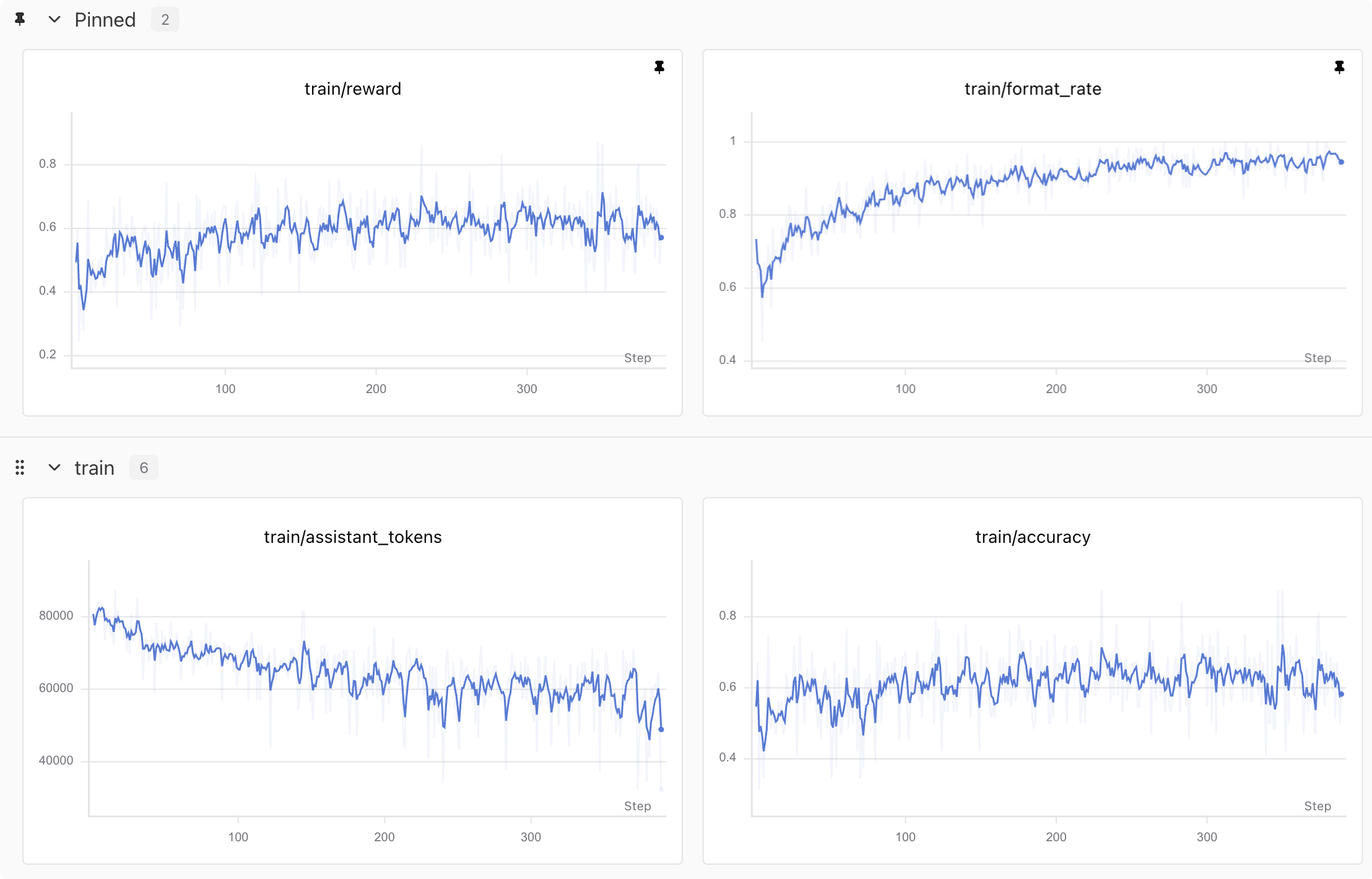
Set --epochs 3 to reproduce the 3-epoch checkpoints. Below are the SwanLab curves from the initial 4B RL epoch 1 run (format compliance climbs near 0.95 while reward and accuracy improve with batch-to-batch variance):
Dev set evaluation
Evaluate on the fixed 256-sample dev set (bench_dev.jsonl, concurrency 16, temperature=0.6, seed=42, up to 8 turns, 16,384 context):
# 4B Base (automatically appends a format reminder when --model-path is omitted)
uv run python eval.py \
    --base-model Qwen/Qwen3.5-4B \
    --output outputs/base-dev \
    --max-tokens 6132 \
    --max-seq-len 16384

# 4B SFT epoch 2 (use --max-tokens 6144 for a budget-matched comparison with RL)
uv run python eval.py \
    --base-model Qwen/Qwen3.5-4B \
    --model-path '<SFT_SAMPLER_PATH>' \
    --output outputs/sft-dev \
    --max-tokens 2048 \
    --max-seq-len 16384

# 4B / 9B RL checkpoint (set --base-model Qwen/Qwen3.5-9B for 9B)
uv run python eval.py \
    --base-model Qwen/Qwen3.5-4B \
    --model-path '<RL_SAMPLER_PATH>' \
    --output outputs/rl-4b-e3 \
    --max-tokens 6144 \
    --max-seq-len 16384
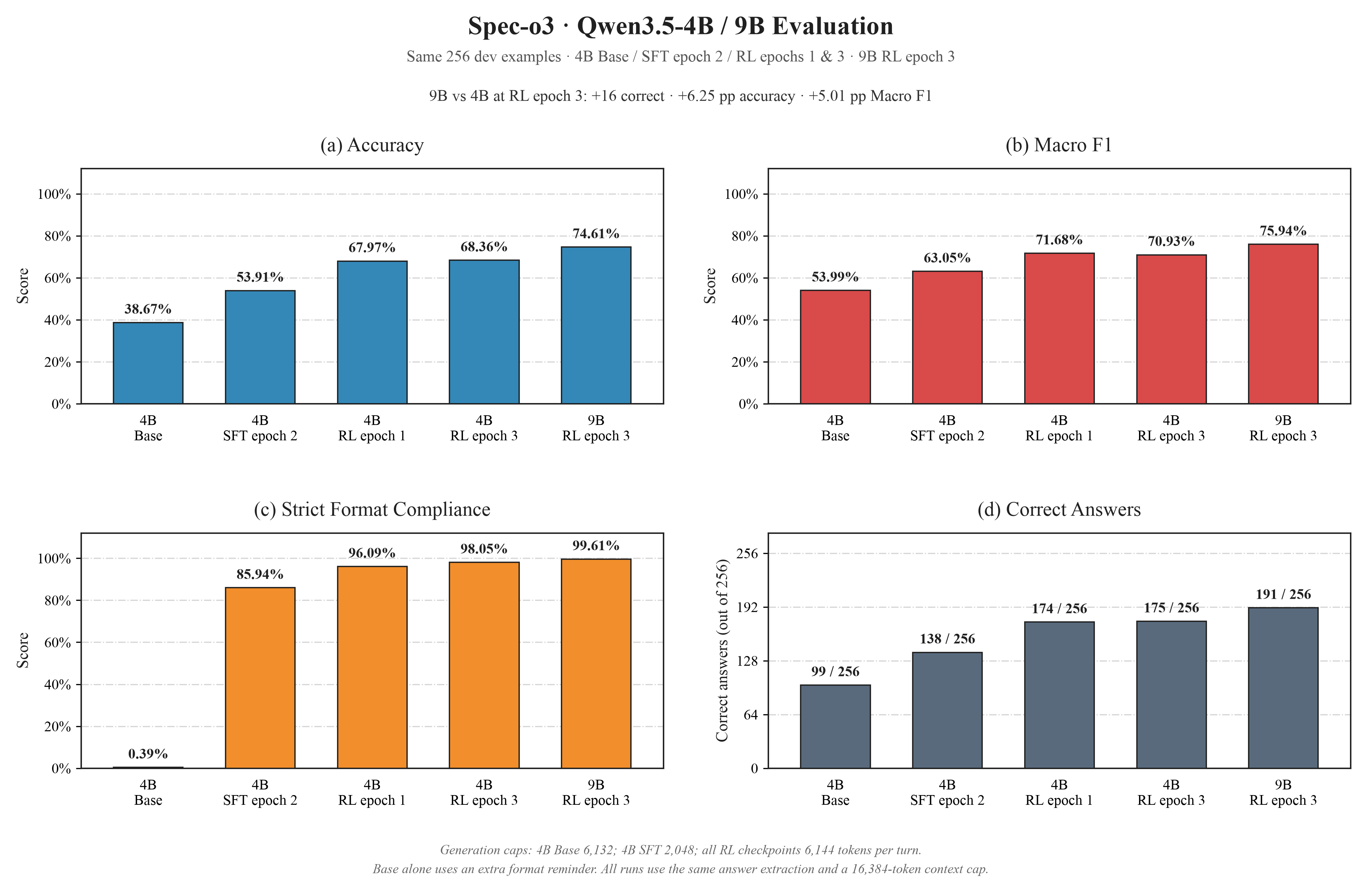
Summary across all five evaluated checkpoints:
| Model / Stage | Macro F1 | Accuracy | Format | Correct |
|---|---|---|---|---|
| Qwen3.5-4B Base | 53.99% | 38.67% | 0.39% | 99 / 256 |
| Qwen3.5-4B SFT epoch 2 | 63.05% | 53.91% | 85.94% | 138 / 256 |
| Qwen3.5-4B RL epoch 1 | 71.68% | 67.97% | 96.09% | 174 / 256 |
| Qwen3.5-4B RL epoch 3 | 70.93% | 68.36% | 98.05% | 175 / 256 |
| Qwen3.5-9B RL epoch 3 | 75.94% | 74.61% | 99.61% | 191 / 256 |
On 4B, SFT adds +39 correct samples (raising Format from 0.39% to 85.94%) and RL epoch 1 adds another +36. 9B RL epoch 3 reaches 191 / 256 with 99.61% strict format compliance and 1,011/1,011 successful tool calls. Per-task F1 for the two epoch 3 checkpoints:
| Model | CC (56) | CV (50) | GM (51) | SS (50) | WD (49) |
|---|---|---|---|---|---|
| Qwen3.5-4B RL epoch 3 | 52.31% | 61.11% | 92.06% | 79.17% | 70.00% |
| Qwen3.5-9B RL epoch 3 | 67.80% | 71.79% | 87.72% | 84.62% | 67.80% |
Metrics to monitor
| Metric | What it checks |
|---|---|
train/loss / val/loss | Mean cross-entropy over supervised assistant tokens during SFT |
train/reward | Mean RL outcome reward across all rollouts |
train/accuracy | Online YES/NO classification accuracy |
train/format_rate | Fraction ending with a strict <answer>\boxed{...}</answer> block |
train/degenerate_fraction | Fraction of questions skipped due to zero within-group reward variance |
train/assistant_tokens | Total assistant tokens entering the PPO update (affected by skipped groups) |
rollout/mean_generated_tokens | Mean generated tokens per trajectory (tracks reasoning length) |
rollout/mean_turns / rollout/tool_calls | Mean turns per trajectory and total tool calls per batch |
Reproduction boundaries
- Dev split and generation budget: reported scores are on the 256-sample dev set (
bench_test.jsonlwith 6,754 samples is unevaluated); historical SFT evaluation usedmax_tokens=2048versus6144for RL, so a 6,144-token SFT re-evaluation is needed for an exact budget-matched comparison. - Residual corrupted symbols in SFT data: 273 trajectories in the public SFT dataset still contain placeholder markers for unrecoverable scientific symbols and were kept as-is.
- Method transfer rather than leaderboard replication: different base models (Qwen3.5-4B/9B), LoRA, 16K context, and smaller batches mean scores are not directly comparable to the paper's 8×H100 numbers.
For the full write-up and additional discussion, see the source repository's Spec-o3 README.
Was this documentation helpful?